When the plan was never the problem
When the plan was never the problem
Intro
Hi hi ho, thanks for coming back one more week. Because I’m pretty sure somebody is reading. One of my personal learnings is that, since there are so many of us in the world, you’re never the only one. You can travel far away, be in a remote place, and you’ll always find other people doing the same as you. And I have to admit: if you’re an agent reading my post, welcome too, hehe.
So this week I want to talk exclusively about Waad, because it’s the project that took all the learnings — and those were about communication. A topic I find absolutely fascinating and that I’ve experienced in several ways: top-down and also horizontally.
Let’s start with communication and soft skills.
Horizontal communication
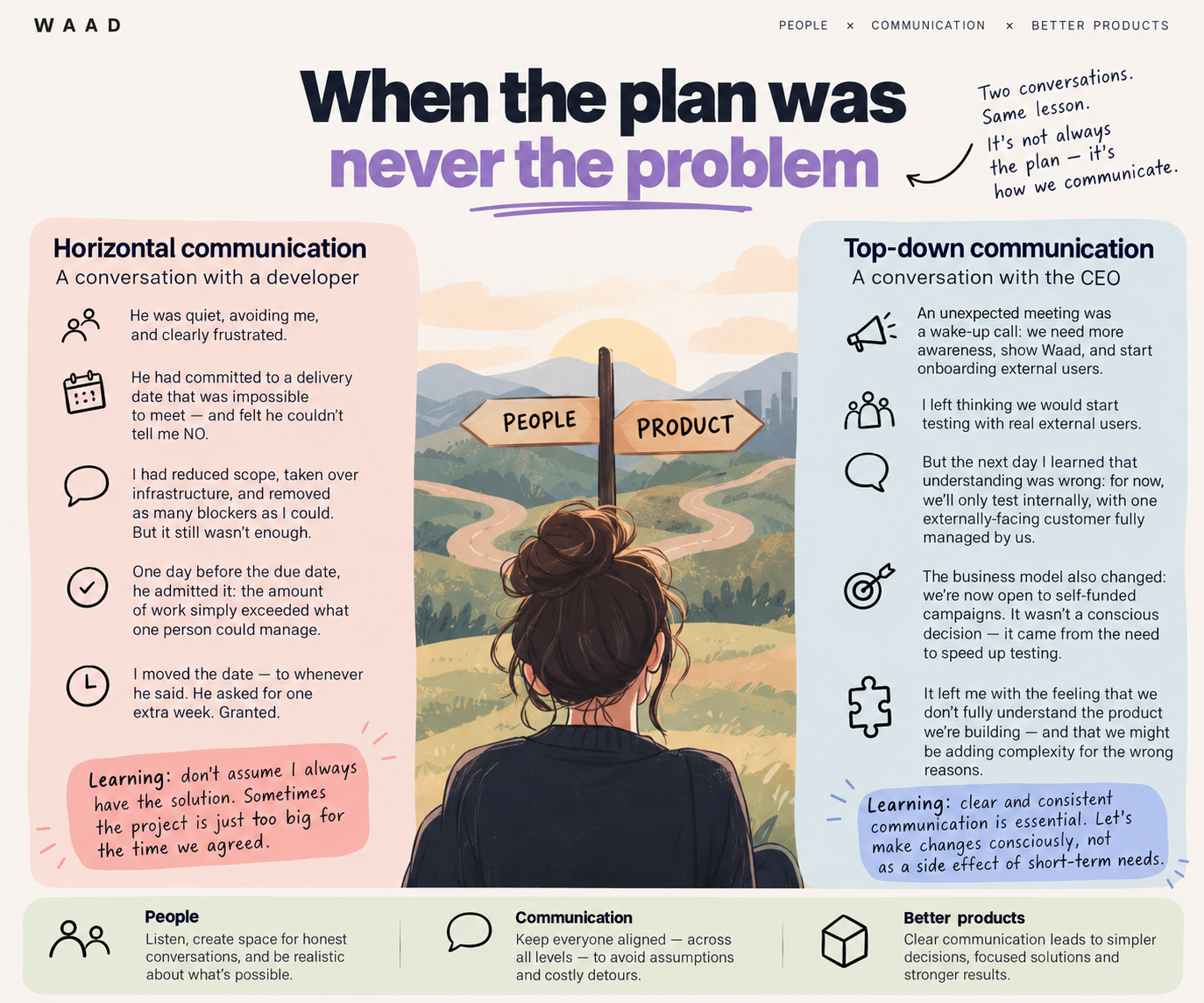
Last week one of the developers was very apathetic in our daily meeting. He usually talks a lot and makes jokes, so his behaviour worried me. It worried me even more when I noticed he was avoiding me. That meant I was the problem. It was impossible to talk to him, but on Monday we finally had the meeting.
At the beginning he was reluctant and kept evading my questions, so it was more of a classic project manager / tech lead discussion where we went over project status. But then, as the conflicting parts started to surface, he began to complain. To summarise a conversation that was fairly chaotic: he was angry at himself, and also at me, because I had pushed him into committing to a delivery date that was impossible to meet.
He was angry that he hadn’t been able to tell me NO — that the due date I’d been pressing him on for weeks was not viable. I gave him my usual reasoning, the one I used every time he had doubts. I couldn’t add more people and my hands were tied on moving the date, so I was cutting scope instead: fewer platforms, no automation, smaller features. I was also helping him deliver things outside the product itself — I took over all the infrastructure and environment configuration, plus the third-party resources.
Honestly, I believed that would have been enough. It wasn’t. One day before the due date, he admitted it was real. I trusted him. I knew he wasn’t lying to me and that he wasn’t underperforming. The amount of work simply exceeded what one person could manage.
The good news is that he wasn’t far off, and everything he had built was solid and ready to ship. So after listening to him, I accepted reality and told him to move the date again — this time to whenever he said. He asked for one extra week. Granted.
Learning for next time: don’t assume I always have the solution to a project’s problems. Sometimes the project is just too big to be manageable in the time originally agreed.
Top-down communication
This one is fresh, as it happened today. Yesterday we had an unexpected meeting with the CEO. I know from experience that when a meeting is announced like that, it’s a wake-up call — and it was. We need more awareness: talk loudly about Waad now that it’s out there, show the product more, and on the tech side, start adding external users to Waad so we can say “it works”.
So I left the meeting thinking about how to start delivering real value to external users. Waad already works; it needs some testing and fine-tuning, but it can undoubtedly support a couple of external users to validate the customer-facing product.
This morning, though, I found out my expectation — or my understanding — was wrong. They didn’t want to show anything to the world, just test it internally. Yes, we will add an external customer, but one that is 100% managed internally by us. It will help us test a “real campaign” without anyone clicking madly around the product. I learned this from one of our team members who acts as a bridge with marketing and business.
Beyond the communication gap, it also had technical implications that, to be honest, affected me. The business model had changed. We had talked at length about wanting one where we own and manage the campaigns. That was etched in my mind after long discussions. This morning it changed: now we’re open to self-funded campaigns. Don’t get me wrong — we built the product knowing this could happen. But my impression is that nobody was aware of that when the decision was made.
Again, we analysed it and, thank God, we had a short-term solution. Fair enough. But it left me with the feeling that somehow we don’t properly understand the product we’re building. And I say that because we didn’t change or extend the business model consciously — it was a side effect of marketing wanting to test.
Because it doesn’t make sense to add special cases to the business model just to speed up testing. If we do it, it should be because we genuinely want a new, extended business model.