How I’m Evaluating My LLM App Before Launch
Intro
Hi everyone! Welcome to my weekly journal, where I share the challenges I face and what I learn while building AI-powered SaaS apps.
This week I’m focusing on one topic from my journey to take LLM-powered apps to production. How do you build an evaluation setup that tells you whether your app is ready for more users?
Let’s get into it.
How I learn something new
Feel free to skip this section if you’re here for the LLM evals. After more than 25 years in IT and hundreds of topics I’ve had to learn from scratch, this is the approach I keep coming back to.
Pick one resource to start with, knowing it may be incomplete or get some things wrong.
Start learning by doing.
Return to the first resource once I have some hands-on experience.
Bring in other resources as my questions get more specific.
Look for tools that already solve the problem.
Evaluate those tools with long-term maintenance in mind.
There’s a lot of reading and a lot of doing. You might notice I haven’t mentioned LLMs yet. I do chat with them to clarify concepts, but at this stage a good old Google search could serve much the same purpose.
I usually start with either a book or a few blog posts. A good book is my favourite because it gives me the context I need to understand the topic. Some books are also marketing tools, and that can affect their quality. I get it. Writing a book is hard, especially when you’re juggling editorial deadlines, reviewer feedback, and the pressure to write something that sells. The process can still be a good way for an author to research a topic deeply and share what they’ve learned.
Blog posts are quicker to get through, but a post drafted by an LLM from an author’s outline can be hard to assess. There may be a genuinely useful insight from the author in there, buried under paragraphs of filler. I’ve also gone back to posts I thought were excellent and, once I knew more, spotted bias, a sales pitch, or claims that were simply wrong.
Still, I’d rather start with an imperfect resource than wait for the perfect one.
It takes me a while to get my head around something new. Maybe I’m getting old. 😄 The quickest way I’ve found to make it click is to try building something. That’s when the real questions come up. I go back to what I read a few days earlier, and suddenly I know which details to pay attention to.
That cycle can take weeks or months. Once I understand the problem well enough, I start looking at tools and frameworks and can judge whether they’d actually help.
That’s where I am now with LLM evaluation.
Getting started with LLM evaluation
I started looking into this four weeks ago. Our app is in a friends-and-family phase, and I’ll admit I’m nervous about opening it up to everyone and having the whole thing blow up in my face.
I started with the Confident AI blog to get familiar with the concepts and the vocabulary. IT has a habit of giving things fancy names, sometimes making a concept sound more complicated than it needs to be.
The first article I read was LLM Evaluation Metrics. It covered several distinctions:
Technical metrics and business metrics
General-purpose metrics and metrics tailored to a specific use case
Evaluations that use an LLM and those that use statistical methods
Evaluating an LLM and evaluating an agent
I found it hard to follow because it introduced several ways of classifying evaluations at once. Parts of it felt more like marketing than a guide to getting started. It still gave me enough vocabulary to start asking better questions.
What I’m actually evaluating
For now, I’m evaluating the final recommendation the app produces after a conversation. The conversation gives the app the context it needs, and the evaluation looks at the resulting recommendation. I want to know two things.
Is it good enough? Does it fit the customer’s situation and give them something useful?
Is it consistent? If I run the same case several times, do I get recommendations that meet the same standards?
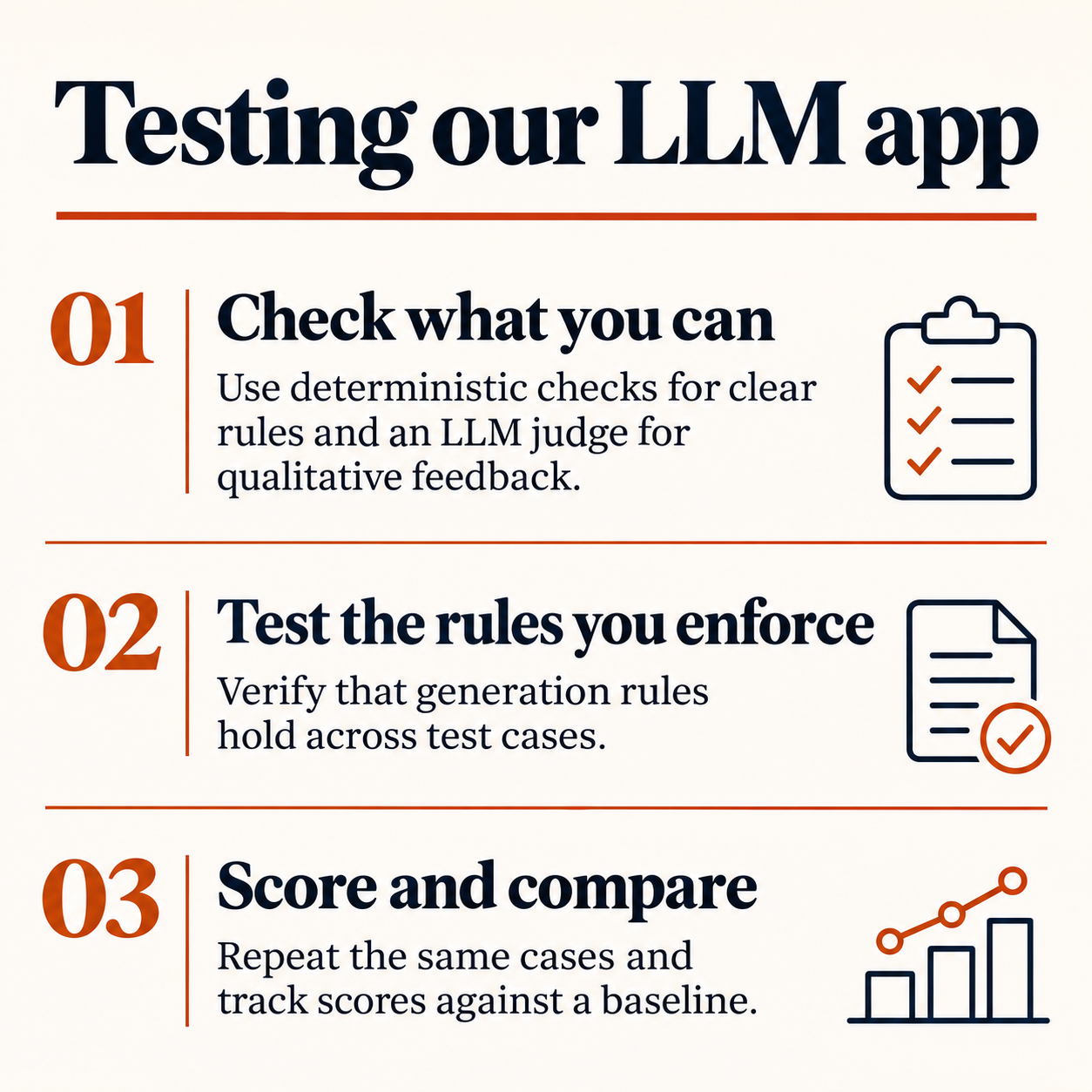
I want scores I can compare across runs. I think of the evaluation as an acceptance test suite that runs separately from the live app. The app can enforce rules when it generates a recommendation, and the evaluation can check whether those rules held up across a batch of cases.
My process looks like this.
Prepare a set of test cases in advance.
Run each case several times in a batch using a setup that matches production.
Check and score the outputs.
Save the results as a baseline and compare future runs against it to spot regressions.
I use two layers to assess the outputs. The first uses deterministic checks. The second uses an LLM as a judge.
Deterministic checks
I split these into rules and expectations. Both give the same result when applied to the same output. The difference is what happens when a check fails.
Rules
A rule defines what a recommendation must satisfy to be valid. For example, the recommended monthly budget might have to meet a minimum based on the customer’s sector or typical transaction value.
The app enforces these rules during generation and blocks a recommendation that breaks one. In the eval suite, I want to see 100% compliance. Every failure is something to investigate.
Expectations
An expectation defines what I’d like to see for a particular test case. I score the recommendation based on which expectations it meets. If it misses one, it can still be a valid recommendation.
That distinction matters because an app can follow every rule and still fall short of what I’d hoped it would recommend in a particular situation.
LLM as a judge
I can write a rule for a minimum budget. It’s much harder to write rules that cover every way a recommendation can be useful or poorly suited to a customer.
That’s where I use a separate LLM call to review and score the recommendation. The judge’s score is advisory. I use it to understand how the system is performing and look for changes in quality across runs.
Where I am now
I’m still building the pipeline. I track only a handful of metrics, and the scores don’t tell me much yet. I’m also iterating quickly and changing my mind as I get a better sense of what’s worth measuring.
In parallel, I’ve started looking at existing tools to see which parts of the pipeline they could handle for me.
That’s where I am with LLM evals. If you’ve built something similar or see a gap in my approach, I’d love to hear from you in the comments.