Coding Agents: When Should You Read the Code?
Intro
Hi everyone, and welcome back to my weekly journal!
31 weeks in a row, with just one week off for holidays. Not bad!
This week, I have more of a reflection to share than a proper journal entry about what I’ve been working on.
And yes, it’s been a busy week with the companies I’m advising. Lots of work around LLM evaluations, diving deeper into how advertising activation works, e-commerce, ERPs, and so on.
But this time, I have some thoughts I’d like to share with you.
So, let’s get started!
Coding Agents: When Should You Actually Read the Code?
I think it’s time to bring a bit of order to all the hype and discussions around AI-based code generation and automation tools (aka coding agents). Should we still read the code they produce? Are developers dead?
Machines produce code now. Fine. Actually, it’s a dream come true for me. I couldn’t be bothered to write code after spending time architecting a solution.
But once the code is there, should I read it or not?
Here’s a mental framework I like to use to answer that question.
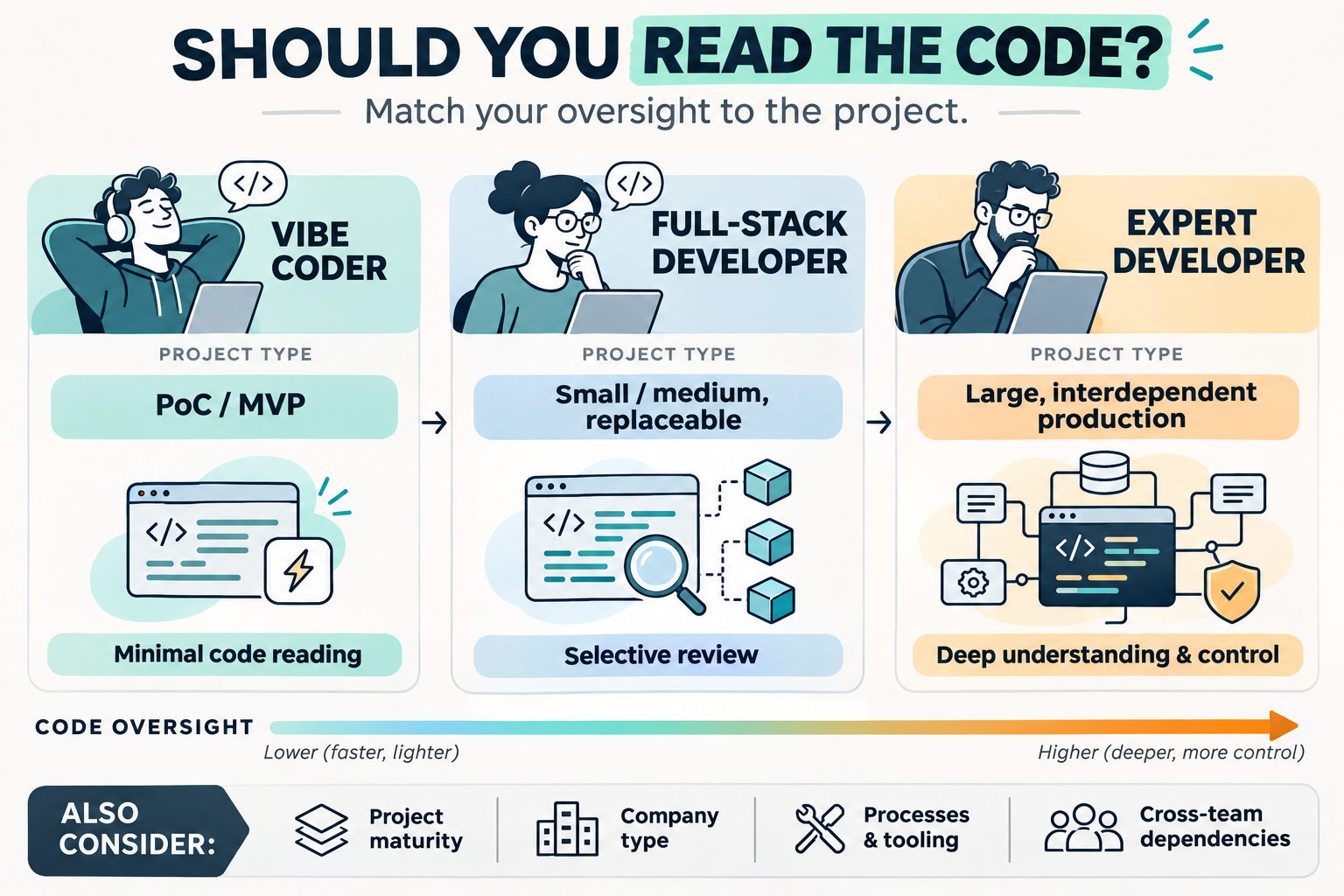
Three Developer Personas
First, based on their knowledge of programming languages and the technology stack, I define three developer personas:
The Vibe Coder
The Full-Stack Developer
The Expert Developer
Then, I match these personas to different types of projects. It’s roughly a one-to-one mapping, with some exceptions.
Matching Developers to Projects
1. PoC / MVP
You don’t necessarily need to read the codebase here. The Vibe Coder approach is often good enough.
2. Small / Medium Projects — Easy to Drop or Replace
This is the middle ground.
The Full-Stack Developer is a good fit, although some parts of the codebase might require deeper knowledge, while others can be handled almost on autopilot using a Vibe Coder approach.
My rule of thumb is simple: in the worst-case scenario, can you throw away an entire module and rebuild it from scratch?
If the answer is yes, you can lean towards the vibe coder, otherwise keep the balance between Full stack and expert from time to time.
3. Large, Interdependent, Production-Grade Projects
This is where expert knowledge becomes essential.
Progress happens more slowly, step by step, while maintaining control over what’s being produced.
For certain parts, modules, or areas of the project, you might be able to move down to a Full-Stack Developer or even a Vibe Coder approach. But you must always remain in control.
It’s Not That Simple, Of Course
This is the basic framework I use. Obviously, it’s a very simplified model.
There are many other factors to consider, such as the maturity of the project or the type of company.
A fintech startup, for example, won’t necessarily approach development in the same way as a well-established bank.
And it’s not just about programming.
Processes, other tools, and how everything interacts with other departments can also influence which approach makes sense.
Still, I think this framework is a useful way to understand when to do what. It also helps demystify coding agents.
Coding Agents Are Multipliers, Not Magic
At the end of the day, coding agents are essentially code-spitting machines, more or less accurate, combined with an AI automation layer and an assistant.
They work incredibly well, but they are ultimately a multiplier of your own capabilities.
If you’re a bad coder, don’t know how to code, or simply don’t want to understand what you’re building, these tools won’t magically make you a better developer. They’ll just replace you.
I think this is especially important for junior developers.
I’ve seen juniors who want to run before they can walk, relying far too heavily on code generation tools. And I understand why: businesses increasingly expect them to deliver output comparable to that of senior developers.
But the result can be a collection of disconnected, unreliable, and uncontrolled code that will eventually blow up in their faces — and in the company’s face as well.
The Pressure to Deliver 10x
Businesses are pushing developers to deliver 10x more, or even beyond that.
This pressure naturally pushes us towards the Vibe Coder approach rather than the Expert Developer one.
The results produced by AI coding agents are often so impressive that, especially in non-enterprise organizations, it’s extremely difficult to justify slowing down development just to understand what’s actually going on under the hood.
I know this pressure well.
I experienced something similar 20 years ago, when I started my career and entered the advertising industry.
Back then, many people came from traditional advertising — TV, radio, and print — and couldn’t understand why engineering took so long to deliver things.
It took time for the entire industry, not just advertising, to understand and accept engineering timelines and requirements.
Now, something similar is happening again. Businesses need time to assimilate what AI really means for software development.
In the meantime, engineers will have to suffer a little.
We have to deal with the pressure to deliver faster, knowing that every concession we make today might become a problem tomorrow.
And guess what? When the system breaks at 3 AM, we’ll be the ones on call fixing it.
Not a particularly good deal, is it?
Keep that in mind the next time you decide to vibe code something.